


27-08-2026
How Web Design Impacts SEO, User Experience, and Business Growth

A business website is often the first point of contact between a company and its potential customers. Before making a purchase, requesting a service, or contacting a business, users increasingly visit its website to understand what the company offers and whether it appears trustworthy.
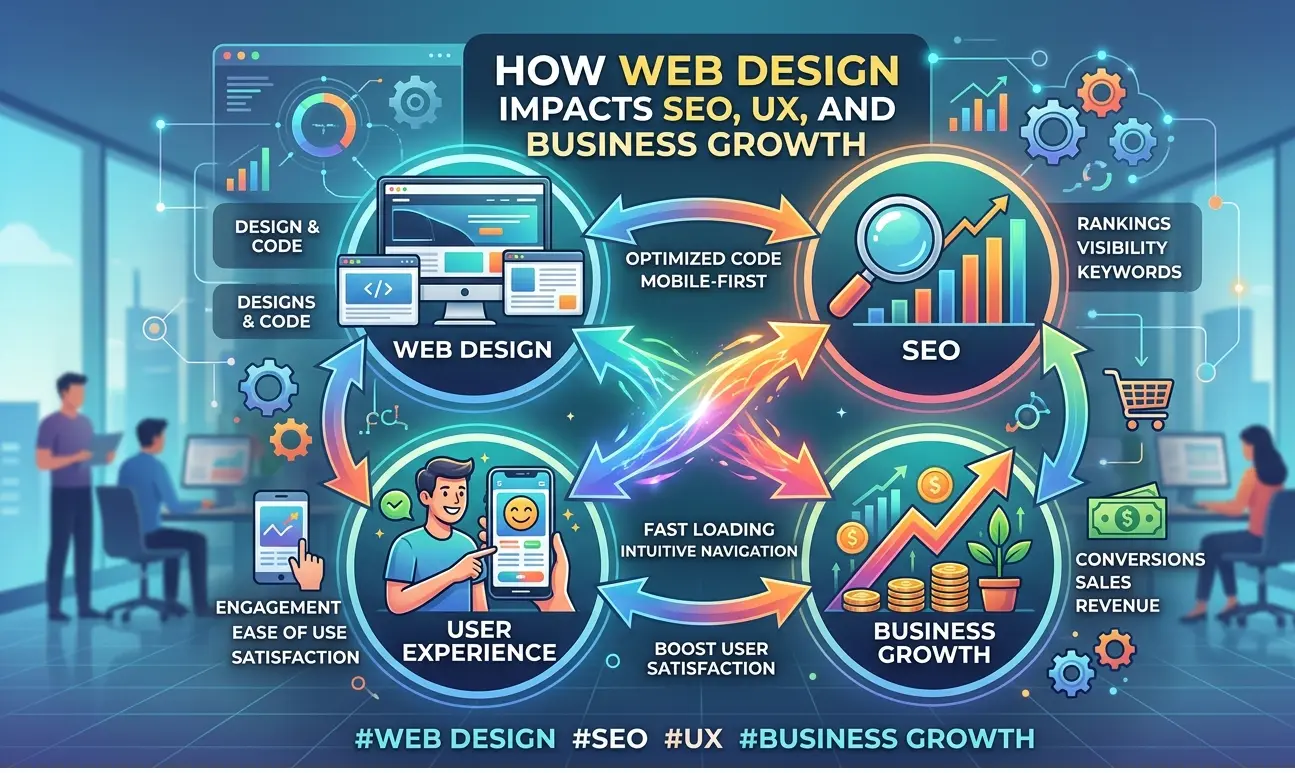
This makes web design much more than a visual exercise. A well-designed website can influence how visitors interact with a business, how search engines understand its content, and how effectively it converts visitors into customers.
For businesses operating in competitive markets such as Dubai, working with a professional web design agency dubai can help create a website that balances appearance, functionality, search visibility, and business objectives.
Looking to partner with us?
Talk to our team today — +971 52 198 5657
The Connection Between Web Design and SEO
Search engine optimization is not limited to keywords and backlinks. Website structure, performance, mobile usability, navigation, content presentation, and technical elements can all influence how effectively search engines crawl and understand a website.
A clear website structure helps search engines discover important pages and understand the relationship between different sections. Proper headings, descriptive page elements, optimized images, internal links, and clean navigation can contribute to a more search-friendly website.
A website that looks attractive but performs poorly can struggle to deliver the visibility a business expects.
Website Speed Matters
Users expect websites to load quickly. When pages take too long to appear, visitors may leave before exploring the content.
Website speed can also affect the overall search experience. Heavy images, unnecessary scripts, poor hosting configurations, and unoptimized code can slow down a website.
Professional development and optimization can help reduce these problems by improving image handling, page structure, code efficiency, and technical performance.
A faster website can create a smoother experience while supporting broader digital marketing efforts.
Mobile-Friendly Design
A significant amount of internet activity takes place on smartphones and tablets. A website that works well on desktop computers but performs poorly on smaller screens can lose potential customers.
Responsive design allows website layouts to adapt to different screen sizes. Text should remain readable, buttons should be easy to tap, navigation should be simple, and important information should remain accessible.
For businesses targeting customers in Dubai and the wider UAE, mobile usability should be considered an essential part of website planning rather than an optional feature.
User Experience and Customer Behavior
User experience describes how easily and comfortably visitors can interact with a website.
When users can quickly find information, understand services, navigate between pages, and complete desired actions, they are more likely to remain engaged.
Good UX involves several elements, including:
- Clear navigation
- Readable content
- Logical page structure
- Consistent design
- Fast loading
- Mobile responsiveness
- Accessible contact options
- Clear calls to action
A website should guide visitors naturally rather than forcing them to search through confusing menus or unnecessary pages.
Building Trust Through Professional Design
A website also communicates the credibility of a business. Poor layouts, outdated graphics, broken links, inconsistent branding, and difficult navigation can make visitors question the professionalism of a company.
On the other hand, a modern and organized website can create a stronger first impression.
Professional design should reflect the company's identity while presenting information clearly. Branding elements such as colors, typography, imagery, and messaging should work together rather than appearing disconnected.
Trust is especially important for businesses where customers need to submit inquiries, make purchases, or share personal information.
The Role of Website Navigation
Navigation is one of the most important elements of usability. Visitors should be able to move between key sections without confusion.
A clear navigation structure can also help search engines understand the hierarchy of a website.
Businesses should organize pages logically and avoid creating unnecessarily complicated menu systems. Important services, product categories, contact information, and company details should be easy to access.
Internal linking can further connect relevant pages and encourage visitors to explore more of the website.
Content and Visual Design Should Work Together
Good design does not replace useful content. Instead, visual elements should help users understand and consume information.
Large blocks of text can be difficult to read, particularly on mobile devices. Breaking content into clear sections, using descriptive subheadings, bullet points, visuals, and appropriate spacing can make information easier to understand.
At the same time, content should provide genuine value rather than simply being created to include search terms.
A strong website combines useful information with an intuitive visual structure.
Calls to Action and Conversions
The ultimate purpose of many business websites is to generate an action. This could be submitting an inquiry, requesting a quotation, booking an appointment, purchasing a product, or contacting the business.
Calls to action should be visible without becoming intrusive.
Examples include:
- Request a Quote
- Contact Us
- Book a Consultation
- Get Started
- Explore Services
- Request More Information
Strategically positioned calls to action can make it easier for visitors to take the next step.
Website Design and Business Growth
A website can support business growth by attracting new visitors, communicating value, generating leads, and strengthening customer relationships.
A well-structured website can become the central destination for digital marketing campaigns. Search traffic, social media visitors, paid advertising audiences, and referral traffic can all be directed toward relevant website pages.
If the website provides a poor experience, marketing efforts may generate traffic without producing meaningful results.
This is why design and marketing should be considered together.
SEO-Friendly Website Architecture
An effective website should have an architecture that supports both users and search engines.
Important service pages should be easy to discover. URLs should be understandable, pages should have clear headings, and related content should be connected through internal links.
Businesses can also organize content around topics that their target customers are searching for.
This approach allows a website to develop topical relevance while providing visitors with useful information.
Security and Technical Reliability
Website users expect businesses to provide a safe and reliable online environment. Security issues, broken forms, unavailable pages, and technical errors can negatively affect both user confidence and business performance.
Regular updates, secure configurations, backups, monitoring, and maintenance are important for keeping a website operational.
Businesses should also ensure that contact forms, payment systems, analytics tools, and other integrations function correctly.
The Importance of Accessibility
A professional website should be usable by as many people as possible. Accessible design can include readable typography, sufficient contrast, descriptive image information, logical navigation, and clear interactive elements.
Accessibility can improve the experience for users with different abilities while also encouraging better overall website usability.
Simple, clear design decisions often benefit every visitor.
Choosing the Right Web Design Partner
Selecting a suitable web design company dubai can have a long-term impact on website performance. Businesses should look beyond visual portfolios and consider technical knowledge, SEO understanding, responsive design capabilities, development quality, maintenance, and communication.
The right partner should understand the company's target audience and business objectives rather than applying the same design approach to every project.
A website should be developed around the specific needs of the business.
Web Design as a Long-Term Investment
A website should not be treated as a one-time project that never changes. Customer expectations, technology, search algorithms, and business goals continue to evolve.
Regular improvements can include updating content, optimizing performance, improving navigation, adding new features, monitoring user behavior, and addressing technical issues.
Working with an experienced web design company can help businesses maintain their digital presence as their needs develop.
Conclusion
Web design influences far more than how a website looks. It affects search visibility, page performance, navigation, customer trust, engagement, lead generation, and the overall digital experience.
Businesses that invest in professional web design services can create websites that are visually appealing while also being functional, search-friendly, responsive, and focused on measurable business outcomes.
For companies competing in Dubai's fast-moving digital marketplace, a strong website can become a valuable business asset. By combining thoughtful design, useful content, technical performance, SEO principles, and clear conversion paths, businesses can create a digital presence that supports sustainable growth.
Frequently Asked Questions
How does web design affect SEO?
Website structure, mobile responsiveness, page speed, navigation, content organization, and technical performance can all influence how effectively search engines crawl and understand a website.
Does website design affect user experience?
Yes. Navigation, readability, loading speed, mobile usability, page structure, and calls to action all influence how visitors interact with a website.
Can good web design increase leads?
A well-designed website can make important information easier to find and provide clear conversion paths, potentially helping turn more visitors into inquiries or customers.
Why is mobile-friendly design important?
Many users access websites through smartphones. Responsive design ensures that pages remain functional and easy to use across different screen sizes.
Should web design and SEO be planned together?
Yes. Integrating SEO considerations during the design and development process can create a stronger technical and content foundation for future search visibility.